How to improve CAASPP test prep for stronger student outcomes

CAASPP testing measures reasoning. Here's how prep can help students think, write, and improve with meaningful feedback.
CAASPP testing season is here. And if you're like most California educators right now, you're staring down a calendar that's too full and a quiet worry that none of it is moving the needle.
You've been teaching your heart out since August, but the data still feels heavy. Somewhere in the back of your mind, you might be thinking: Are we preparing students for the right thing?
After spending a decade in a middle school ELA classroom, and now working directly with California districts on CAASPP testing readiness, I think the answer is often no. Most CAASPP test prep is solving the wrong problem, and it has nothing to do with how hard teachers are working.
What is CAASPP Testing?
CAASPP (the California Assessment of Student Performance and Progress) is California’s statewide assessment system for English language arts, math, and science. It provides insight into how well students are meeting grade-level standards, and offers a snapshot of their progress over time.
Those results reflect more than content knowledge. They capture how students approach complex tasks, which is why it’s important to look closely at what the test asks them to do.
What does CAASPP measure?
Before building a single practice activity, it's worth considering what CAASPP measures in practice. Across ELA, math, and science, a consistent pattern emerges. Students are asked to explain their thinking, use evidence from text or data, navigate multi-step prompts, write clearly to a rubric, and sustain focus across longer tasks.
CAASPP tests articulation, not recall. It rewards students who can show their reasoning and express their understanding clearly in writing. Students who struggle most are often those who know the content, but can’t demonstrate it on the page.
That distinction changes how we should be preparing them.
What can we learn from 2024-25 CAASPP testing data?
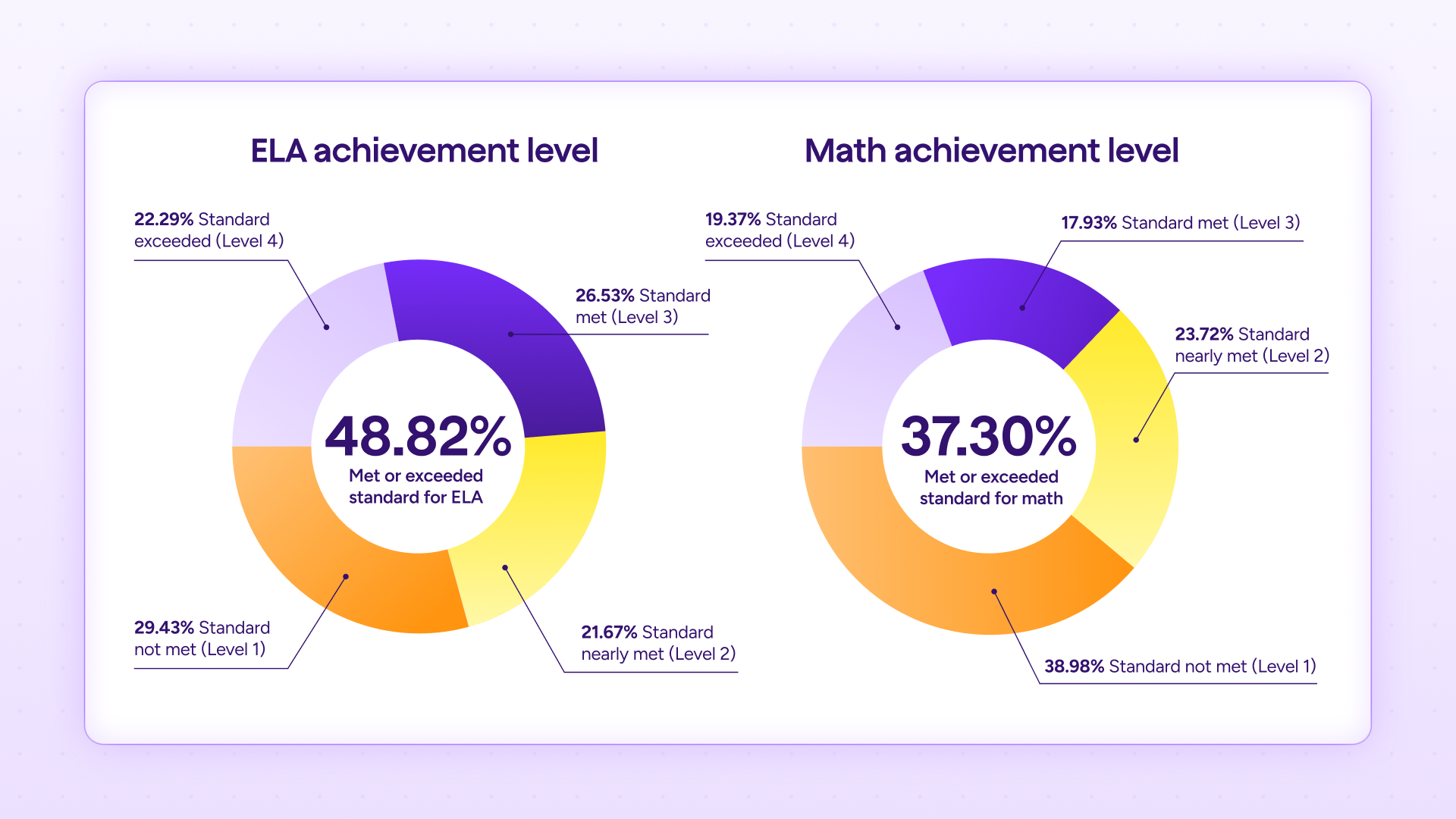
The 2024–25 results cover nearly 3 million California students across grades 3 through 11. A few patterns stand out:
- About 39 percent of students aren’t meeting standards in math statewide, climbing to nearly 49 percent by Grade 11
- In ELA, about 29 percent of students aren’t meeting standard
- When you include Nearly Met students, more than half of California students aren’t currently meeting grade-level expectations in English Language Arts
In math, CAASPP testing shows that reasoning is a bigger challenge than procedures
- Students are performing worse on Mathematical Practices (applying strategies to complex problems and explaining reasoning) than on Concepts and Procedures
- Nearly 42 percent of students are below standard on Mathematical Practices compared to 38 percent below standard on procedural knowledge
- On Communicating Reasoning specifically (thinking logically and expressing thoughts to solve a problem), only 17 percent of students are performing above standard across all grades
The gap shows up most clearly in explaining thinking.
In ELA, we see the same pattern
- The steepest drops appear on writing, research and evidence, and multi-step performance tasks
- Not on multiple-choice reading comprehension
- 28 percent of students are below standard in Writing vs. 24 percent in Reading
- 31 percent are below standard in Writing and Research vs. 28 percent in Reading and Listening
Students can navigate a text, but consistently writing about it is harder.
A significant group of students are close to meeting the standard:
- Roughly 24 percent of students are in the “Nearly Met” category
- In ELA Writing, 51 percent are in the Near Standard band
For many of these students, the barrier is demonstrating what they already know, not a gap in content knowledge.
Source: California Department of Education, 2024-25 CAASPP results
Why does traditional CAASPP test prep fall short?
Research tells us that frequent low-stakes practice, immediate actionable feedback, and opportunities to revise improve performance. None of this is new, and I believe every teacher already knows it.
The challenge is doing it consistently without making the workload impossible.
Building a meaningful extended response task takes time. Giving useful feedback on 30 of them takes even more. Doing that twice a week across multiple classes throughout the testing season? At that point, it stops being a workload and starts being a second job.
So most CAASPP test prep defaults to what’s fastest to create and easiest to grade, multiple choice. This happens to be the format that least resembles the tasks where students are actually struggling.
When the feedback loop gets cut, practice stops building the skill.
What does effective CAASPP practice look like?
Effective preparation comes down to the right kind of practice. Students need repeated opportunities to explain their thinking, get feedback, and revise. That cycle builds the skill CAASPP measures, and it’s also the hardest part to sustain manually.
For many students, especially hesitant writers, the barrier is exposure. They haven’t had enough chances to practice explaining their thinking without pressure or delay.
Think about baseball. You don’t get better by watching. You get better by taking at-bats. Low-stakes reps where you can try, miss, and try again. That’s what most CAASPP-style practice is missing.
For many students, especially the ones who stare at a blank page or shut down at extended responses, MagicStudent is often the first time they can practice without an audience. No hand raised. No waiting weeks for a grade. Just try, get feedback, and try again.
For some students, it’s the first time the game has felt playable.
How MagicStudent gives students the CAASPP practice they need
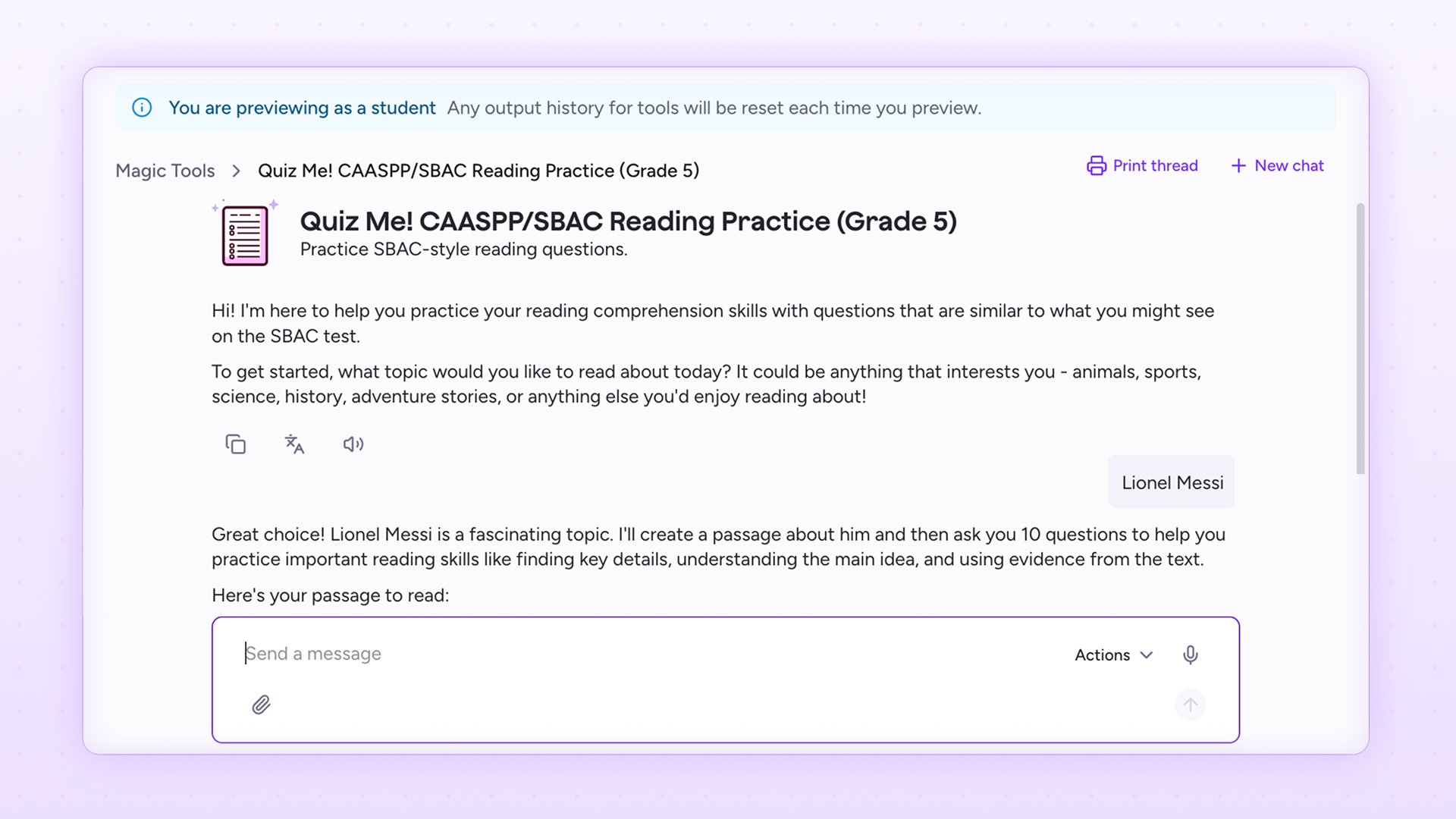
MagicStudent is an educator-controlled AI space where students practice the exact cognitive work CAASPP testing requires, including explaining reasoning, using evidence, and responding to multi-step prompts.
Students receive immediate feedback and can revise in real time. Teachers choose the tools, set the focus and guardrails, and stay involved. MagicStudent handles the repetition while giving teachers full visibility into student thinking.
That visibility goes beyond submission tracking. Teachers can see what students tried, where they got stuck, and whether they are approaching the standard. Many describe CAASPP testing as the first time they can observe thinking in real time, not just the final answer.
Students aren’t interacting in an open chat. They’re working through structured, teacher-designed tasks that ask them to think, respond, explain, and try again. That distinction matters for leaders thinking about responsible AI use.
How to use MagicStudent rooms for CAASPP prep
- Whole class modeling: Project a student room and think through reasoning together. Model strong responses before students practice independently.
- Small groups: Assign targeted skill practice without reteaching the whole class. Students close to meeting standard can practice explaining their thinking while you work with others. As they work, you can see who is approaching the standard and who needs a different entry point, without collecting and reviewing 30 responses.
- Intervention: Use the same task with added structure for students who need more support. Adjust room settings to reduce cognitive load while maintaining rigor.
- Centers: Drop a room into your rotation for meaningful independent practice. Students engage with CAASPP-aligned tasks while you run small groups.
- Quick checks: Use rooms as bell ringers or exit tickets with immediate feedback. Regular, low-stakes practice builds the habit of explaining thinking.
Sharing is straightforward. Rooms connect to Google Classroom, Canvas, Seesaw, and Schoology. Students can join with a link or code.
90+ CAASPP-aligned MagicStudent rooms, ready to assign
Because I know what testing season actually costs teachers, I didn’t want to hand you a framework and say “go build.”
I built 90+ MagicStudent rooms aligned to CAASPP across ELA, math, and science, organized by subject and grade band and designed around the task types where students struggle most.
- ELA: All four claim areas, including reading comprehension, editing and revising, research and evidence, and writing performance tasks with rubric-aligned feedback
- Math: Conceptual understanding, problem solving, mathematical reasoning, and performance tasks
- Science: CAST-aligned for grades 5, 8, and 11
- ELPAC: Practice hubs for grades 2 through 12
Every room is customizable by topic, grade level, complexity, or source texts after assigning, but they work exactly as-is. Think of these as practice reps, not test prep packets.
Customizing CAASPP practice without changing the skill
One of the biggest frustrations with traditional test prep materials is that they weren’t made for your students. Teachers end up spending Sunday nights adjusting reading levels, swapping topics, and adding scaffolds. The content is okay, but the fit never quite works.
MagicStudent rooms are different because customization happens inside the tool. After assigning a room, a simple AI command changes the student experience without changing the underlying skill or standard.
Most teachers I’ve worked with tend to use four approaches:
1. Match student voice and engagement
Connect practice to what students actually care about with commands like:
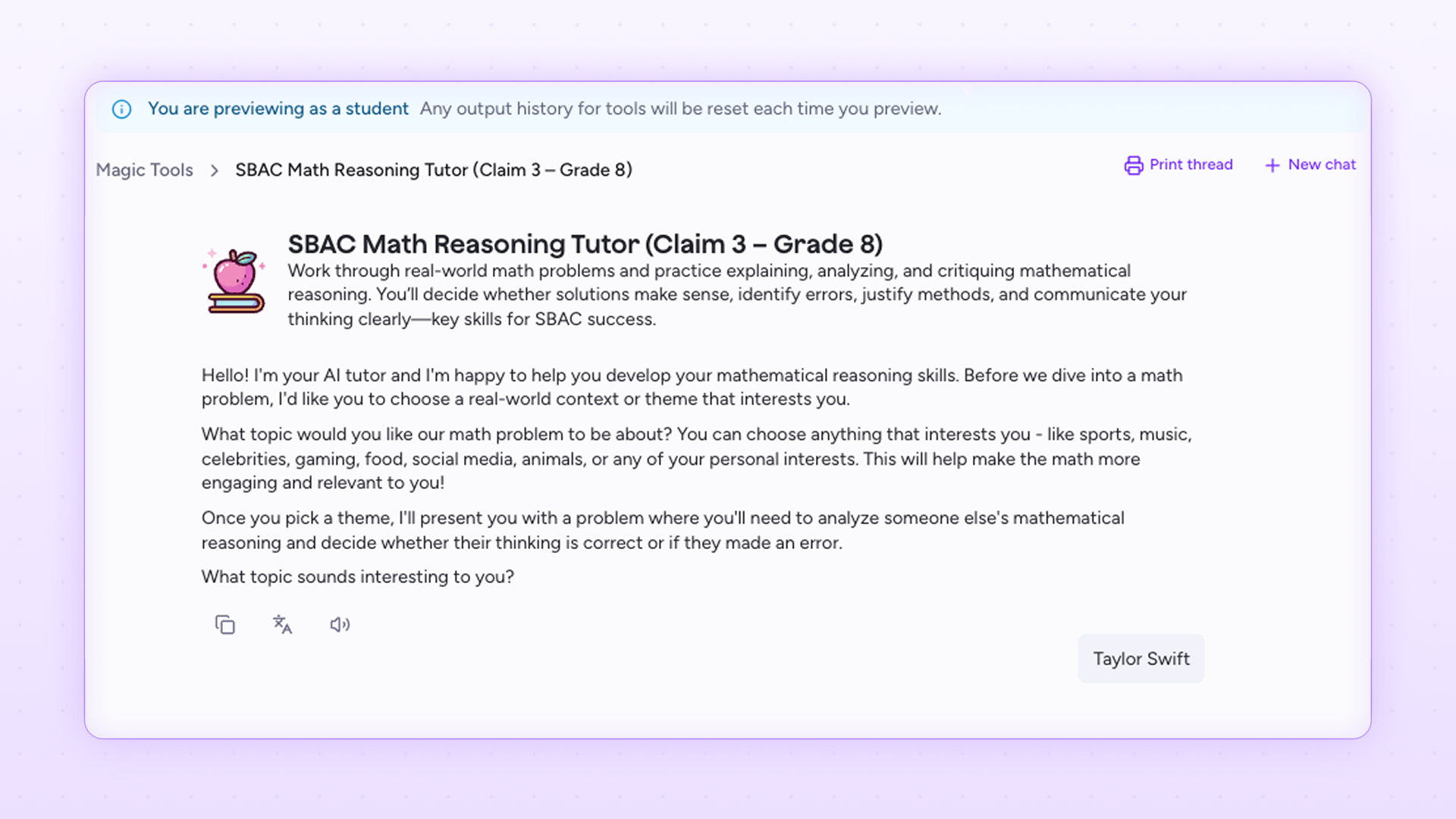
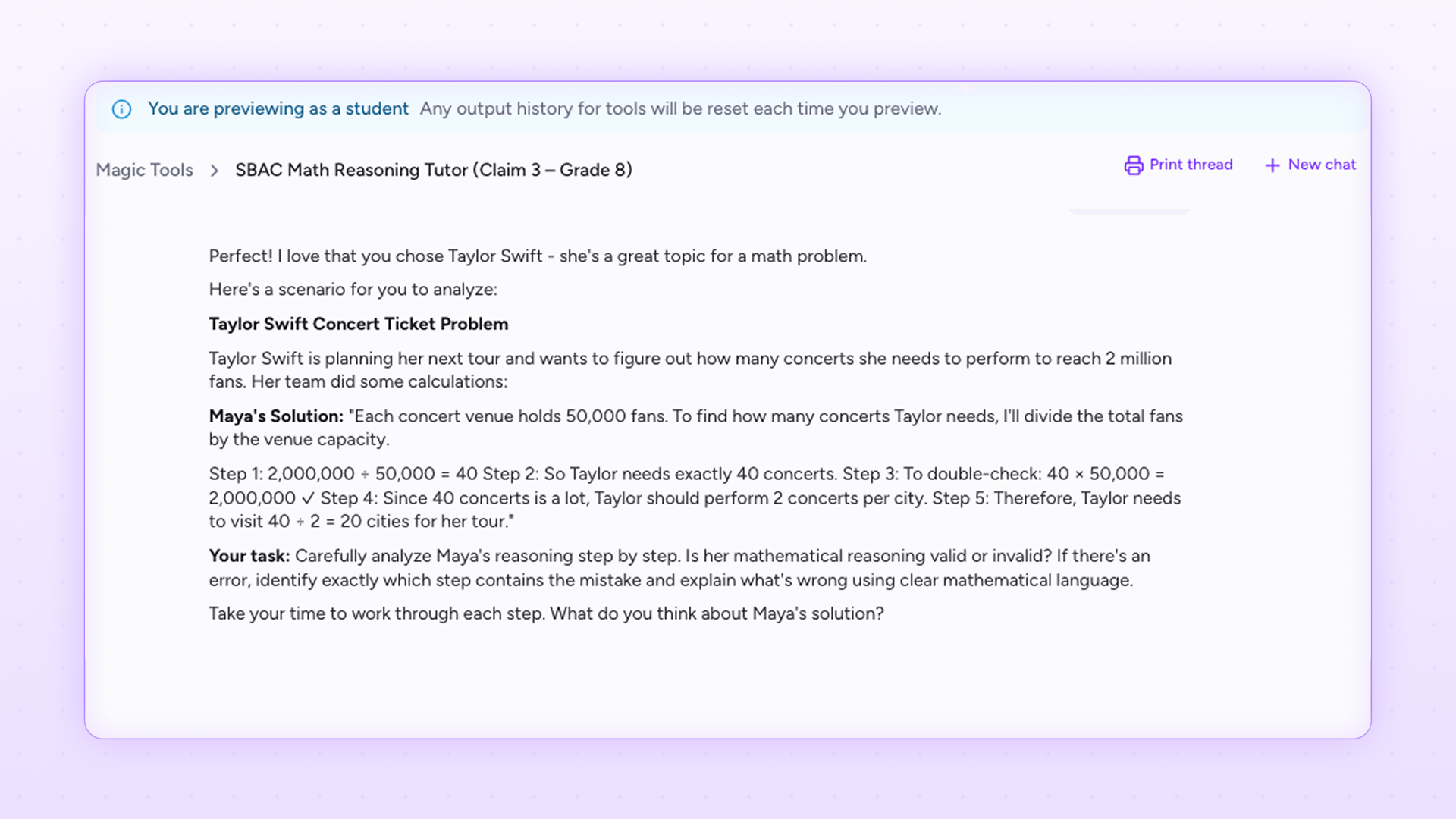
- Make all the questions about Taylor Swift
- Use Gen Alpha slang in every third prompt
- Offer topic choice so students pick what they're responding about
The reasoning skill stays the same. The context becomes something students actually want to engage with.
2. Support comprehension without lowering rigor
Add commands like:
- Bold Tier 3 vocabulary
- Include a bilingual glossary in English and Spanish
- Define any word a 5th grader might not know
These supports meet students where they are without softening the cognitive demand.
3. Clarify the task structure
You might target one skill at a time, or add commands like:
- Respond in bullet points instead of paragraphs.
- Limit responses to two sentences.
- Provide feedback in a table format instead of prose.
For students who get lost in open-ended prompts, this kind of structure can be the difference between shutting down and actually trying.
4. Reduce cognitive load
- Chunk multi-step tasks
- Number each step
- Add sentence starters for each response
- Ask one reflection question at the end, like “What strategy helped you most?”
- Apply UDL principles to the task while keeping the standard intact
None of these changes lower what CAASPP is asking students to do, but they do change how students access the practice, which is where many get stuck.
As CAASPP season approaches, the data is pointing clearly to where students need support. What helps is more of the right kind of practice, delivered in a way that’s actually sustainable for teachers.
Your students know much more than their scores show. Let’s give them the space to prove it.
Ready to get started? Access all 90+ free CAASPP MagicStudent rooms.
How can schools improve CAASPP test scores without increasing teacher workload?
Schools can improve CAASPP scores by embedding standards-aligned writing, reasoning, and feedback into daily instruction rather than adding separate test prep.
What types of classroom activities best prepare students for CAASPP testing?
Activities that require students to explain their thinking, use evidence, respond to multi-step prompts, and write to clear rubrics best prepare them for CAASPP.
Why do students struggle with CAASPP writing and reasoning tasks?
Students often struggle because they can understand the content but lack practice clearly explaining their thinking and supporting it with evidence in writing.
How can districts support teachers during CAASPP test preparation season?
Districts can support teachers by providing aligned resources, reducing unnecessary tasks, and prioritizing instructional strategies that build writing and reasoning skills.
What role does feedback play in improving CAASPP performance?
Feedback improves CAASPP performance by helping students refine their thinking, strengthen their use of evidence, and better align their responses to scoring rubrics.