How should school districts budget for AI?

Learn how school districts can build AI into school budget planning, account for costs, identify funding sources, and measure long-term value.
AI is becoming a bigger part of K–12 education, and districts are deciding what that means for their budgets. The good news is that building AI into school budgeting doesn’t require an entirely new approach.
District leaders can start by looking at AI alongside the priorities already shaping their school budget planning. That means thinking beyond the price of the tool to how it will be used, supported, and funded.
Thinking through those questions early can help leaders make thoughtful investments that can grow with their schools, supporting classrooms over time.
How should AI fit into school budget planning?
AI should be considered as part of the same school budget process districts use for other technology and instructional spending. District leaders can consider how AI supports existing priorities, what resources it will require, and whether the investment can be sustained over time.
Start with the work a district has already committed to. That could include improving instructional quality, supporting teachers, expanding access to personalized learning, or preparing students for a future where AI will be part of college and careers. AI investments should connect back to those priorities and fit within the district’s existing technology and strategic plans.
As part of the school budget planning process, districts also need to account for the resources required to make an AI investment successful, including implementation, professional learning, and ongoing support. Involving instructional, technology, and finance leaders early gives districts a better picture of what will be needed before purchasing decisions are made.
Looking beyond the first year is important, too. A pilot may begin as a limited or one-time expense, but a successful AI tool can quickly become part of the day-to-day work of educators and students. Leaders don’t need to know exactly what future adoption will look like. They can plan for the possibility of broader use and let what they learn from early implementation guide future spending.
What should districts account for in an AI budget?
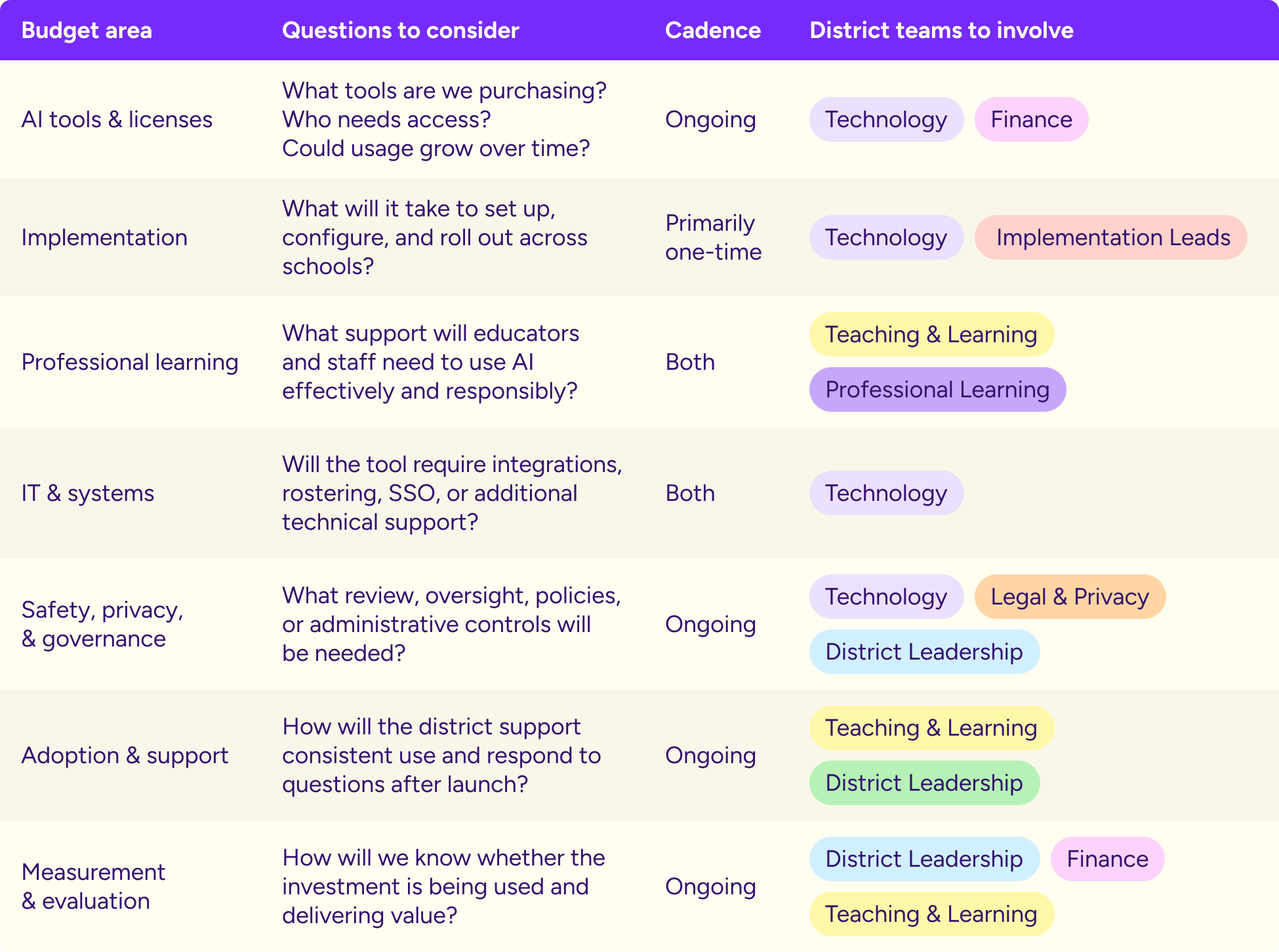
A K–12 AI budget should account for more than the price of a license or subscription. The full investment will depend on how the technology will be used and how broadly it’s adopted.
A small pilot may require fewer resources than a district-wide rollout. Beyond licensing, districts may need to budget for implementation, system integrations, professional learning, ongoing support, evaluation, and staff time.
Looking at the full initiative early can help decision-makers compare options more accurately and determine what’s realistic within the current school budget.
How should districts plan for AI beyond the first year?
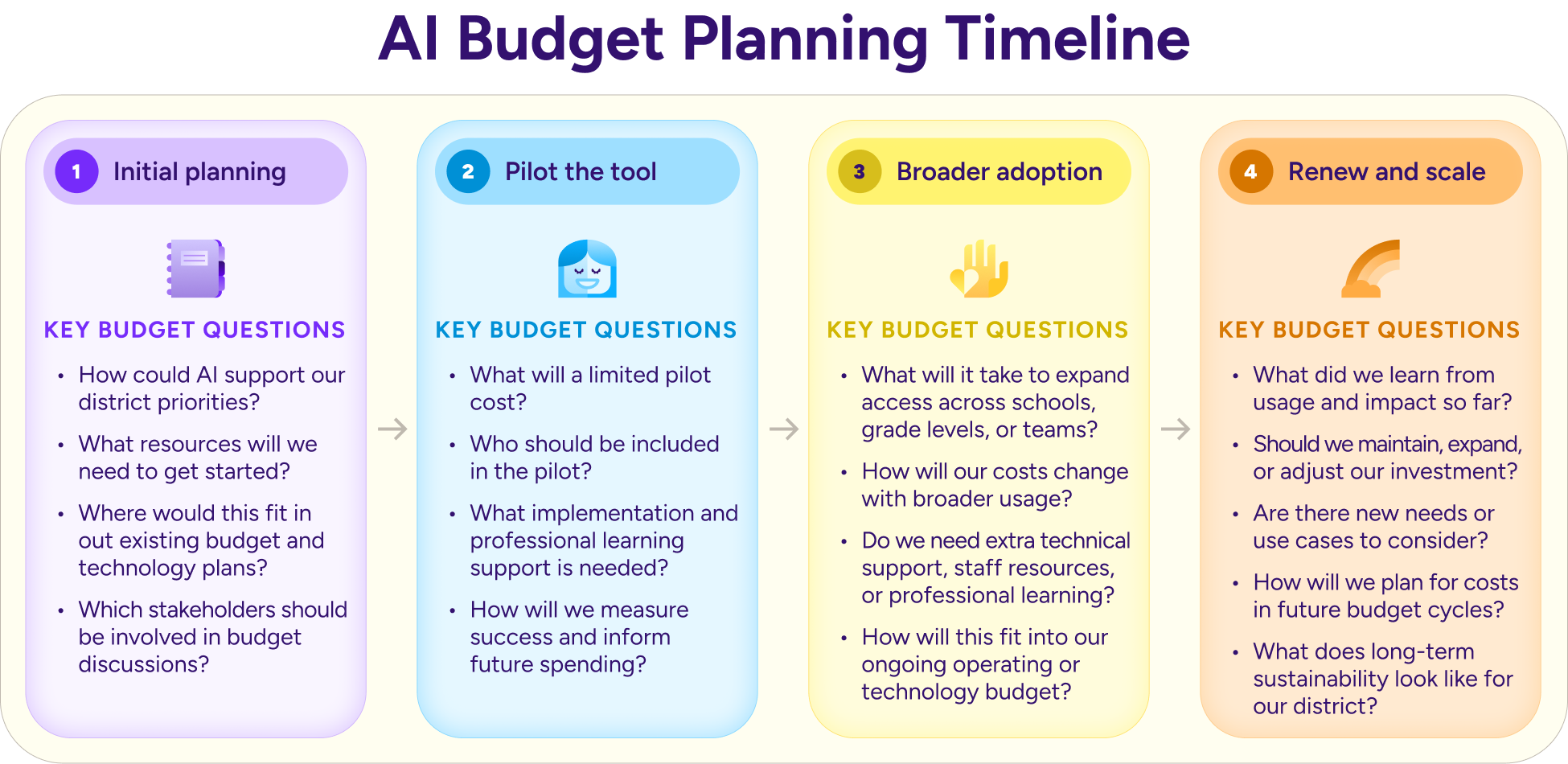
Leaders should expect their approach to AI to evolve after the first year. Early use can help leaders understand what’s working, where more support is needed, and what broader adoption could mean for future school budget planning.
For many districts, school budgeting for AI will change as adoption grows. AI adoption often starts with a pilot or a smaller group of educators and schools. That gives leaders an opportunity to learn before making a larger investment. How often is the tool being used? Where is it making a difference? What support do educators need? Who else could benefit from access?
Those answers can shape how schools plan for the next budget cycle. If a district decides to expand access, it may require more licenses, professional learning, implementation support, or technical resources. A tool that started as a pilot expense may also need to move into a recurring technology or operating budget.
Renewal is another opportunity to take stock. Leaders can look at adoption, outcomes, and changing priorities before deciding whether to maintain, expand, or adjust the initiative. This gives leaders room to plan ahead without having to predict exactly what AI use will look like years from now.
How can school districts fund AI tools?
School leaders may be able to fund AI tools through existing technology or operating budgets, as well as federal, state, local, or grant funding. The right funding approach for a school district’s AI budget depends on how the technology will be used and the requirements tied to each funding source.
For some districts, AI may fit naturally into an existing technology budget, particularly when it becomes part of the district’s broader technology plan. In other cases, funding may connect to a specific instructional priority, professional learning initiative, or student support program.
External funding can offer additional options. Federal and state programs, local funding, and grants may support technology or related initiatives when the planned use meets current eligibility requirements. Because those requirements can change, decision-makers should confirm that an AI investment is an allowable use before building it into the school’s budget.
Funding may also change as an initiative grows. A pilot could begin with grant or other limited-term funding, for example, while a tool that becomes part of long-term district operations may eventually need a place in the recurring budget.
How should districts evaluate whether an AI investment is worth the budget requirements?
Districts should define what they want an AI initiative to accomplish before deciding how much to spend or whether to expand it. Defined goals make it easier to see whether the technology is being used and delivering enough value to justify its place in the school’s AI budget.
Value can show up in different ways. Leaders might look at whether educators are saving time, whether a tool is being used consistently across schools, or whether it’s helping teachers better support students. They may also consider implementation costs and how well the technology supports district priorities.
The right measures will depend on why the district invested in AI in the first place. A tool purchased primarily to support educators may have different measures of success than one introduced to give students guided opportunities to build AI literacy. Setting those expectations early gives leaders better information when it’s time to renew, expand, adjust, or reconsider a purchase.
How can district leaders build a stronger case for AI investment?
A strong case for AI investment in K-12 districts starts with a specific need. Show how the technology supports a priority the district has already identified, from strengthening instruction to preparing students to use AI well.
Then show how the district plans to put it into practice, including who will have access and how educators will be supported. Be specific about the safeguards in place and how the district will evaluate whether the technology is working.
Decision-makers should also have a realistic view of the funding decision, including implementation of AI tools and their ongoing costs. Getting finance, technology, instructional, and school leaders on the same page about the goals, costs, and measures of success can help build alignment during the school budget process and before a request reaches the board.
Together, that gives school boards and other stakeholders the information they need to make an informed decision.
How MagicSchool supports sustainable AI planning for school districts
MagicSchool is built specifically for K–12 schools, giving districts one connected AI platform for educators and students. District leaders get the visibility and safeguards they need to guide AI use across schools, while educators get practical tools for their day-to-day work and students get guided opportunities to build AI literacy.
With district-level controls, built-in safeguards, and support for implementation and adoption, schools can bring AI into classrooms within an environment designed for K–12 from the start.
A shared approach can also make long-term school budget planning simpler by giving school systems one environment they can support and build on as adoption grows. Ready to explore what MagicSchool could look like in your district? Get in touch.
How should schools budget for AI?
Schools should budget for AI as part of their broader instructional technology strategy, considering the tools themselves as well as implementation, professional learning, support, security, and ongoing evaluation. Planning for the full investment can help leaders build AI into their budgets more intentionally.
What should schools include in an AI budget?
An AI budget should account for more than software licenses. Schools should consider implementation, professional learning, technical support, security and privacy requirements, integrations, and staff time.
How much should districts budget for AI tools?
There’s no single amount that works for every district. The right budget will depend on district size, who needs access, existing technology, implementation goals, and the support required. Starting with specific use cases can help decision-makers determine what they need before setting a budget.
What funding sources can schools use for AI?
Schools may be able to use existing technology or operating budgets, along with eligible federal, state, local, or grant funding. Districts should confirm that the planned use meets the requirements of each funding source.
How can districts measure the value and ROI of AI tools?
Districts can look at educator time saved, adoption, instructional impact, student support, implementation costs, and progress toward district goals. Establishing goals and baseline measures before implementation makes it easier to understand whether an AI investment is delivering value over time.