6 common concerns about AI in classrooms and what school boards should know
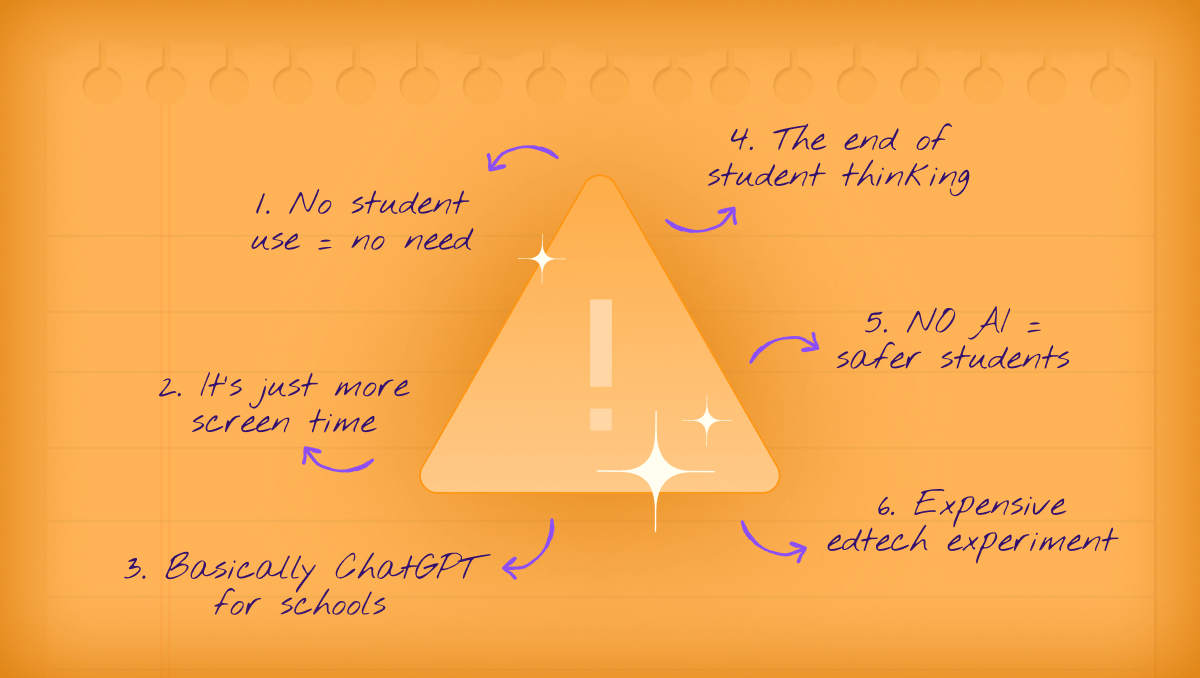
Explore six common concerns about AI in schools, from screen time and student safety to learning outcomes, and what school boards should consider.

AI is showing up in school board meetings across the country, raising questions about what its growing presence means for students, educators, and schools.
Does AI mean more screen time? Will students stop thinking for themselves? What happens to their data? Does introducing AI create another avenue for cheating? And with district budgets already stretched, is this something schools should be paying for at all?
Parents, educators, and board members are right to ask. Recent research suggests parents don’t see safety and AI readiness as an either-or choice. In a 2026 national poll of more than 1,500 parents of K–12 public school students, families expressed a desire for both strong safeguards and preparation for an AI-enabled future.
These conversations involve everyone helping shape how AI is introduced, governed, and used in schools, from board members weighing policies and investments to district leaders evaluating tools, educators considering what AI means for teaching and learning, and families trying to understand what these decisions mean for their children.
That makes it especially important to start with a shared understanding of what AI in schools can, and should, look like. As districts make decisions about AI, separating some of the most common myths from the realities can help school communities ask better questions, set clearer expectations, and move forward with confidence.
1. "If students aren't using AI, districts don't need an AI platform."
The reality: Student access is only one part of AI implementation. How teachers use AI can shape the learning experiences and outcomes in their classrooms.
Teachers are already navigating AI, whether they’re creating instructional materials, differentiating lessons, providing feedback, or helping students understand the technology they encounter outside of school. That makes educator AI literacy a key part of a district’s approach, even when student access is limited or paused, but many teachers are still navigating this shift without formal support. According to Gallup research, just 18% of public K–12 teachers say they’ve received formal guidance from school administrators on using AI tools.
With MagicSchool, districts can support educators while keeping student access disabled, giving leaders the flexibility to introduce AI at their own pace, establish clear expectations, and build educator confidence before deciding whether or how students should use it.
What school boards should ask: Does our AI strategy give us control over who has access, and can that access change as our policies evolve?
2. "AI in schools means more screen time."
The reality: AI can support learning that happens away from the screen, too.
When students use AI at school, screen time is part of the conversation. Schools also need to consider how that time is being used, what students are learning, and whether AI has a clear role in the lesson.
AI can also support teachers without adding to student screen time at all. Educators can use MagicSchool to create lesson plans, assessments, differentiated materials, discussion questions, rubrics, and other resources that students ultimately use offline. Districts can also use MagicSchool without enabling direct student access, giving schools control over where and how AI fits into instruction.
Federal guidance is increasingly emphasizing a similar approach. In August 2026, the U.S. Department of Education encouraged schools to consider the instructional value of education technology, minimize unnecessary screen time, and evaluate which learning needs the technology is intended to address.
What school boards should ask: Is this technology adding screen time for its own sake, or helping educators and students accomplish something instructionally valuable?
3. "Classroom AI is basically ChatGPT with a school logo."
The reality: AI built for schools can work very differently from the general-purpose tools students might encounter on their own.
With MagicStudent, teachers determine which tools students can access and when, while districts have visibility and administrative controls over how AI is used. Student experiences are designed around educational purposes, with safeguards built specifically for K–12 environments.
That becomes especially relevant as students encounter increasingly sophisticated AI products outside of school. Common Sense Media’s 2026 research found that AI is already embedded in young people’s lives, while just over half of kids surveyed said they’d been taught how to use it safely. The organization has also raised concerns about AI companionship and other experiences that may be inappropriate for minors.
Schools can give students a more structured place to learn how to use AI responsibly, with educators setting the purpose, boundaries, and expectations for how it’s used.
What school boards should ask: Was this product designed specifically for students and schools? What controls do educators and district leaders have that they wouldn’t have with a consumer AI tool?
4. "AI will do students' thinking for them."
The reality: AI can shortcut student thinking when it’s designed or used that way. In the classroom, it can also be designed to support the learning process and keep students doing the thinking.
This is one of the most understandable concerns families have about AI. Students need opportunities to wrestle with ideas, make mistakes, develop their own thinking, and build foundational skills, which is why the way AI is designed and used in the classroom is so important.
MagicSchool’s student tools are designed to scaffold learning and guide students through their thinking without simply producing finished work for them. In one recent classroom example, a teacher and researchers from Utah State University built a MagicSchool chatbot that prompted students to deepen their reasoning while preventing the chatbot from generating their final responses.
Researchers found that students generally produced stronger initial drafts and more complete final discussion posts, and the findings offer an encouraging example of how AI can support student thinking when it’s designed around a clear instructional purpose. We’re learning more about that potential, too. Stanford’s 2026 review of the evidence on AI in K–12 found a rapidly expanding body of research, while noting that more rigorous studies are still needed.
What school boards should ask: How does the AI keep students engaged in the learning process and doing their own thinking?
5. "Keeping AI out of school keeps students safer."
The reality: Students are already encountering AI outside of school, which makes learning how to navigate it safely increasingly important.
Families are right to be concerned about privacy, inappropriate content, AI companionship, over-reliance, and other emerging risks. Common Sense Media also found that some young people are already using AI as a confidant, while nearly half reported never having a conversation with their parents about AI safety.
These findings raise important questions about the safeguards surrounding student-facing AI. A learning tool shouldn’t pretend to be a child’s friend, encourage emotional dependence, or keep a student engaged for engagement’s sake. It should have a clear educational purpose, strong boundaries, and adults in control.
MagicSchool has taken a public position on these principles and published standards for mitigating companionship risks in student-facing AI. MagicSchool does not use student data to train AI models, encrypts data in transit and at rest, and gives districts control over student access.
As AI becomes a bigger part of students’ lives, districts have an opportunity to give them a safer, more structured environment to learn how to use it. That means considering where students encounter AI, who is guiding them, and what protections are in place.
What school boards should ask: What happens when a student uses this AI? Who can see that activity? What data is collected? What safeguards are in place? Can the district turn student access off?
6. "AI is another expensive edtech experiment without evidence behind it."
The reality: Districts can look at a growing body of evidence to understand whether AI is delivering value in their schools.
Measuring the impact of any education technology is complex, and student outcomes are influenced by far more than a single platform or tool. And with generative AI, the research base is also still developing. Still, early studies and district results are beginning to show where thoughtfully implemented AI can make a difference.
Researchers at Utah State University found stronger initial drafts and more complete final responses in a classroom using a MagicSchool-powered feedback scaffold. Districts using MagicSchool have also reported encouraging results. Harmony Public Schools reported 66 percent overall student growth on assessments, including 70 percent among special education students and emergent bilingual students, while a Pittsburgh Public Schools CTE classroom saw NOCTI scores increase 18 percent from pre-test to post-test.
For district leaders, evaluating impact can include a wider set of signals. They can look at adoption and usage, teacher time saved, how well a tool supports instructional goals, whether educators find it useful, what visibility leaders have into its use, and whether it can replace other tools rather than adding another disconnected one.
The U.S. Department of Education encourages schools to take a similarly thoughtful approach, considering what learning problem a tool solves, who should use it, when it should be used, and what evidence demonstrates its value for teaching and learning.
What school boards should ask: What evidence supports this investment, how will our district measure its impact, and what would tell us it's time to change course?
What this means for school boards
There’s no one AI policy that’s right for every school system. Districts are moving at different speeds, with some beginning with educators before introducing student-facing AI, and others taking a more gradual approach across the board. Each community will make its own choices based on its students, policies, and priorities.
Making choices starts with good information and the ability to ask hard questions. School boards should expect clear answers about privacy, safety, instructional purpose, educator oversight, accessibility, evidence, and district control, and AI providers should be prepared to provide them.
At MagicSchool, we welcome those questions because schools should understand exactly what they’re introducing into their classrooms, and families deserve that same clarity.
If your district or school board is navigating these conversations, we’re here to help you find the answers you need and make the decisions that are right for your community. Get in touch.
Is AI safe for students to use in school?
AI can be used safely in schools when districts choose tools with strong privacy protections, age-appropriate safeguards, educator oversight, and clear boundaries for student use. Schools should understand what data is collected and maintain control over when and how students access AI.
Does AI in schools increase student screen time?
Not necessarily. Teachers can use AI to plan lessons, differentiate materials, create assessments, and support instruction without students spending any additional time on screens.
Will using AI in school hurt students’ critical thinking skills?
It depends on how AI is designed and used. AI can shortcut thinking, but it can also be used to ask questions, provide feedback, and scaffold learning while keeping students responsible for the thinking and final work.
How is AI designed for schools different from ChatGPT?
AI built specifically for schools can give teachers and district leaders more control over what students can access and how they use it, as well as what safeguards are in place. General-purpose AI tools aren’t designed around K–12 learning, student safety, or district oversight.
How should school districts evaluate AI tools?
Districts should consider student safety and privacy, instructional value, educator oversight, accessibility, evidence of impact, and the level of control and visibility the tool provides. They should also decide upfront how they’ll measure whether the technology is delivering value.


.jpg)