What school districts should know about the cost of AI in education

Learn what contributes to the cost of AI in education, including software pricing, implementation, training, and ongoing expenses for school districts.
A school district might start exploring AI with a handful of teachers, a small pilot, and a relatively modest budget. But what happens when that pilot succeeds and hundreds or thousands of educators and students are ready to use it?
That's when the financial picture can get more complicated.
The cost of AI in education extends beyond the price of a software license. Districts also need to consider what it takes to introduce a new platform across schools, train educators, support ongoing use, and make sure the technology can grow alongside their needs.
And while AI software pricing is an important part of the equation, the lowest upfront price doesn't necessarily translate to the lowest overall cost.
So how can district leaders build a budget that accounts for the full investment? Let's look at the costs to consider, the questions worth asking vendors, and how to plan for AI adoption that lasts.
What contributes to the cost of AI in education?
The cost of AI in education depends on several factors, including software licensing, implementation, educator training, technical support, and ongoing administration. What a district ultimately spends will depend on how many people use the platform, its existing technology, and the support needed to bring AI into classrooms.
Some platforms include onboarding, professional development, and administrative tools in their licensing agreements, while others charge separately. There's also the time district teams will spend getting everything up and running, from IT setup to instructional planning and educator support.
Here's a breakdown of the major cost categories to consider:
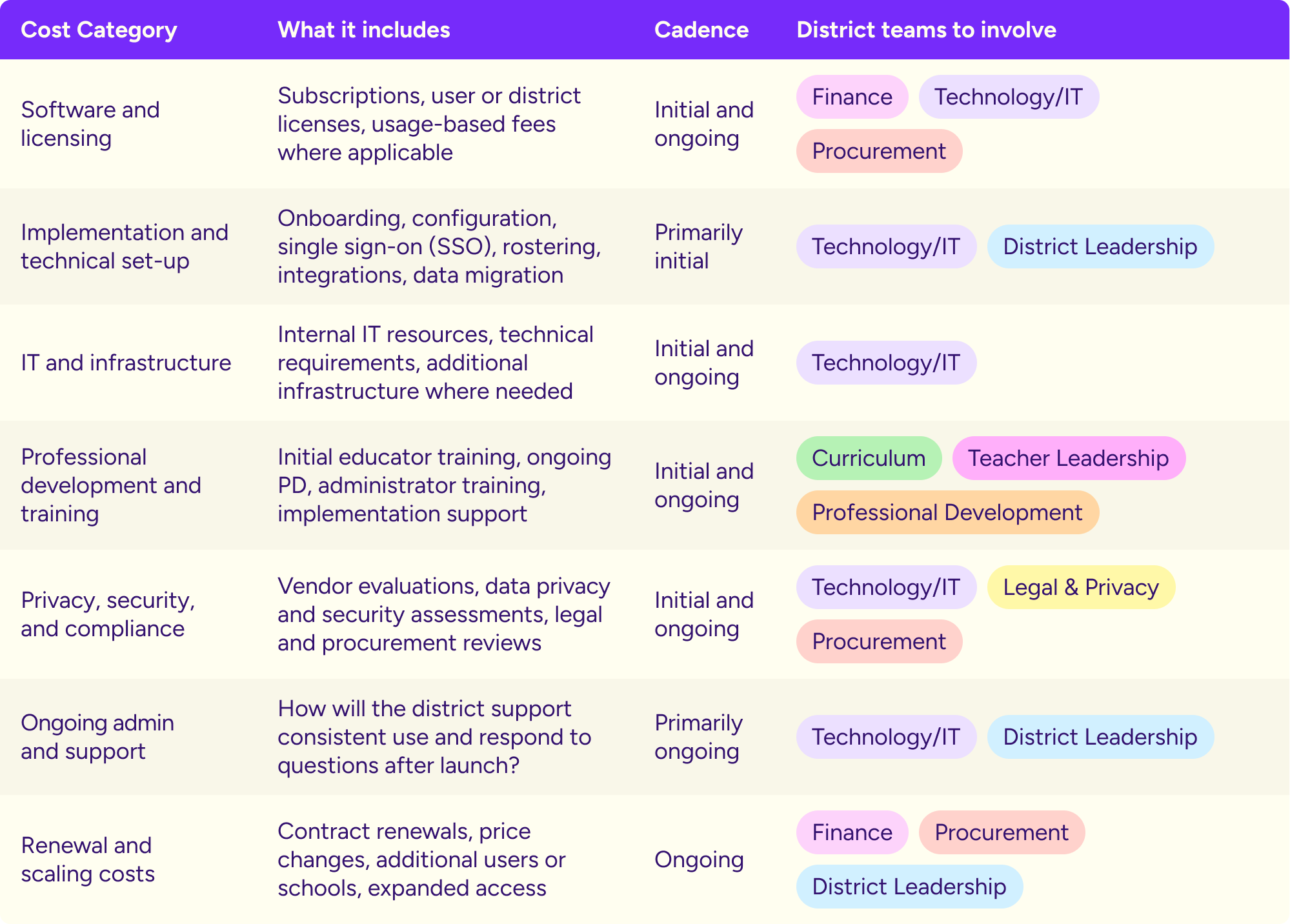
Not every district will incur separate expenses in each category. The key is understanding which services are included in a vendor's AI software pricing, which require additional funding, and which will draw on existing staff resources.
How do AI software pricing models affect district budgets?
AI software pricing models determine how districts are charged for access to AI tools and how those costs may change over time. Vendors may charge based on the number of users, the schools covered, actual usage, or a combination of factors. Understanding these differences makes it easier to compare options and see how costs might change as more schools begin using AI.
It's also important to consider a vendor's pricing model and what's included in each plan. Vendors may offer Free, Plus, or Enterprise plans with different features, administrative controls, and support levels. However, an Enterprise plan could still be priced per user, across an entire district, or through a combination of fees.
Here's how common AI tool pricing structures can affect district budgets:
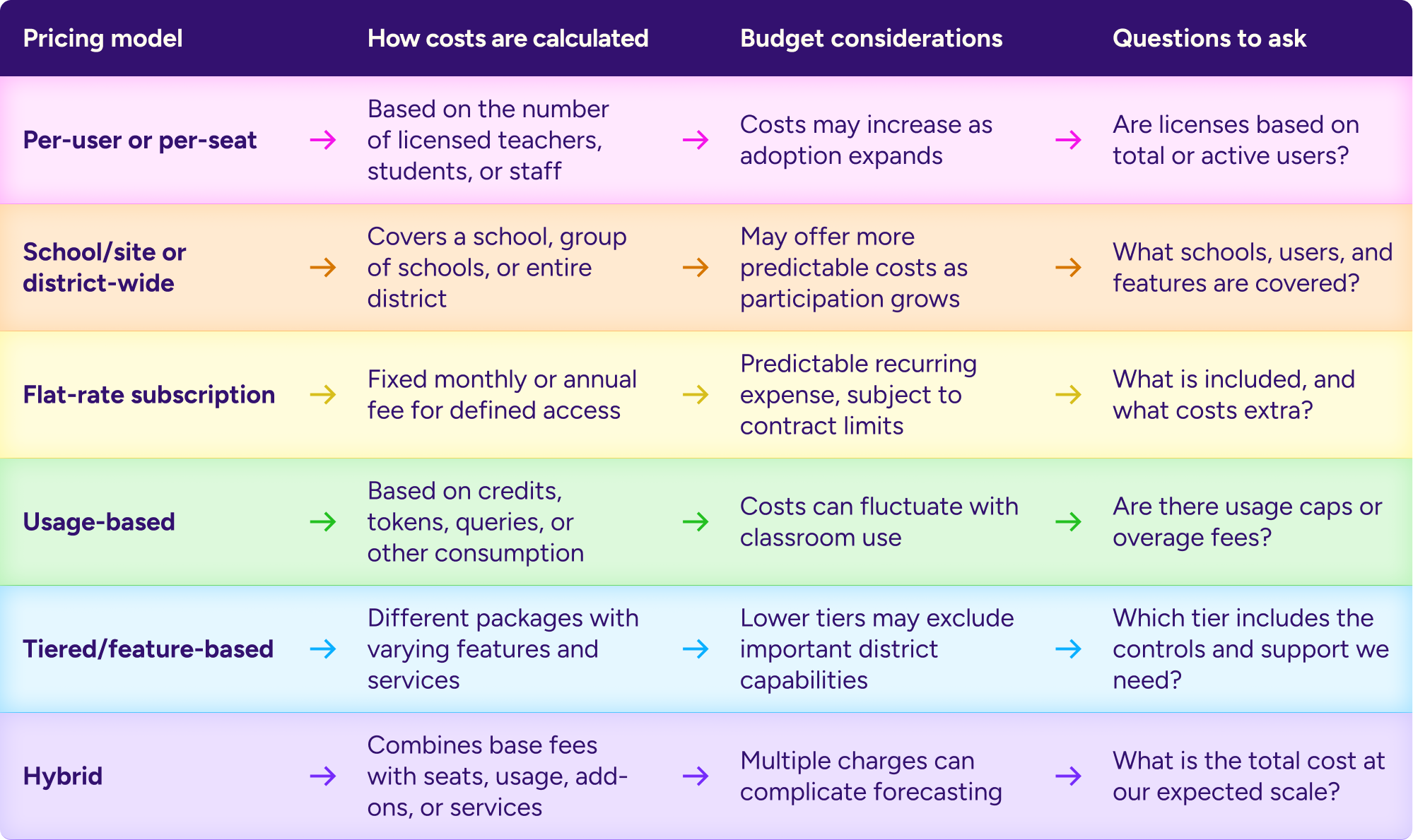
When comparing education software pricing, districts should ask how costs may change as adoption grows, which services are included, and whether additional fees apply.
What costs should districts consider beyond the software license?
Beyond the software license, districts should account for technical setup, staff training, privacy and security reviews, and ongoing administration. These expenses may involve additional vendor fees, internal staff time, or both. Understanding what's included in the contract and what the district will need to manage independently is essential to estimating the full cost of AI in education.
Implementation and technical integration
Even an easy-to-use platform takes some work to introduce across a district. IT teams may need to configure single sign-on (SSO), set up rostering, manage user permissions, or connect the platform with existing district systems.
A platform with built-in integrations and implementation support can make that work easier for district IT teams. It's worth asking what's included when comparing AI software pricing.
Professional development and educator readiness
Providing access to AI doesn't automatically mean educators will feel prepared to use it. Teachers need opportunities to explore the tools, understand district expectations, and learn how AI can support their instructional goals.
Districts should account for initial onboarding, ongoing professional development, and the time instructional leaders or teacher champions may spend supporting colleagues.
Training is especially important when districts plan to introduce student-facing AI tools, where educators need guidance on appropriate use, supervision, and AI literacy.
Privacy, security, and compliance
Before bringing AI into classrooms, districts need to understand how a platform protects student information and meets applicable privacy requirements.
These reviews may involve IT, procurement, legal, and district leadership teams, along with data-sharing agreements, security documentation, and administrative safeguards.
Choosing a platform designed for K–12 use, with appropriate privacy protections and administrative controls, can help simplify this work.
Ongoing administration and support
The work doesn't end when a platform launches. Districts may need to manage accounts, troubleshoot access issues, monitor adoption, update policies, and support educators as their needs evolve.
These responsibilities can add to existing workloads, even when they don't appear as separate line items in a budget.
The takeaway for district leaders: Ask vendors to identify what's included in the license, what carries an additional fee, and what requires district staff time. This helps clarify the resources needed to support AI adoption long after the initial rollout.
How should districts think about the cost of an AI pilot versus district-wide adoption?
The cost of AI in education can change significantly as districts move from a small pilot to broader implementation. A pilot typically involves fewer users and limited setup, while district-wide adoption requires more extensive planning for licensing, training, technical support, and ongoing administration.
A pilot gives districts a chance to see what works, what support teachers need, and where unexpected costs might come up. But supporting a handful of teachers is different from introducing AI across multiple schools, grade levels, and departments.
Here's how financial planning considerations may evolve at each stage:
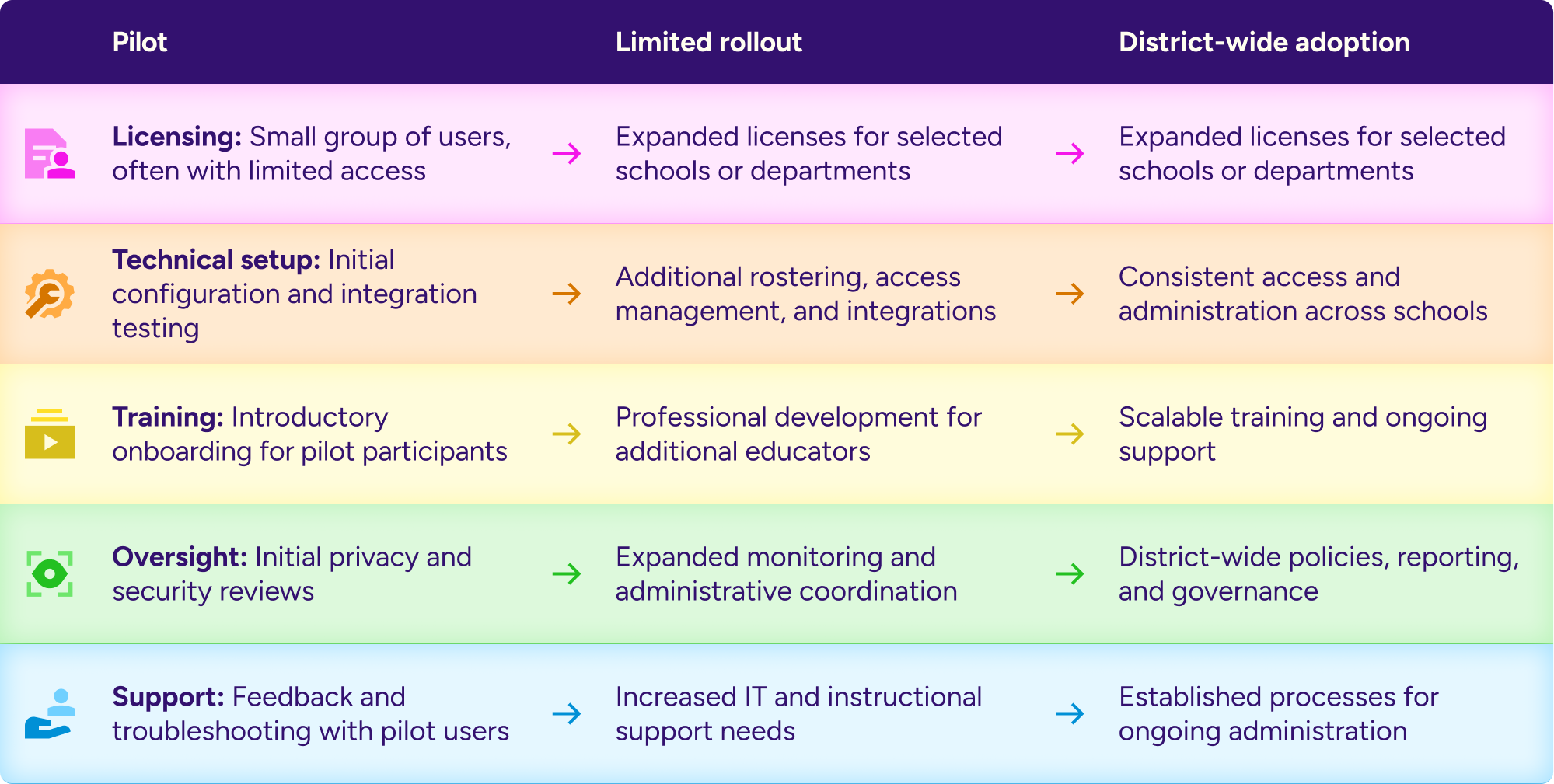
Early lessons and learnings can help districts build more accurate budgets and make informed decisions about expanding access.
For a closer look at how pilots fit into a broader implementation strategy, explore our guide to building an AI roadmap for K–12 districts.
How can districts estimate the true cost of an AI investment before purchasing?
To estimate the cost of AI in education, districts should look at the full investment over time, including licensing, implementation, training, and ongoing support. A realistic estimate also accounts for how many people will use the platform, which services are included in the vendor's contract, and how costs may change as adoption grows.
Before signing a contract, here are five ways to get a clearer picture of what your district can expect to spend:
1. Define the scope of adoption
Start with who will use the platform. Will it be teachers only, or will students, administrators, and support staff have access too? And are you planning a pilot, a phased rollout, or a district-wide launch? These decisions shape licensing, technical requirements, and support needs.
2. Request a detailed breakdown of vendor costs
Ask vendors to explain their AI software pricing structure and provide a complete breakdown of what's included. This should cover licensing, onboarding, integrations, professional development, technical support, and any additional features or services.
Clarify contract terms, renewal conditions, and potential costs for adding users or expanding access.
3. Account for internal staff time and resources
Work with IT, curriculum, procurement, and school leadership teams to identify responsibilities the district will manage internally.
Estimate the time needed for setup, training, privacy reviews, administration, and ongoing support, even when these activities don't require additional spending.
4. Model costs beyond the first year
Consider how expenses might change over several years as adoption expands or contracts come up for renewal. It's worth looking at a few scenarios, including what happens to the budget if twice as many educators or students start using the platform.
5. Validate assumptions with vendors
Review the estimate with prospective vendors to confirm which expenses are fixed, which may vary, and whether the district has accounted for necessary services and support.
By the time you're ready to make a decision, you should have a clear picture of what your district will pay, what your teams will need to take on, and how those costs could change over time.
How MagicSchool supports sustainable district AI adoption
The right AI platform should make life easier for your district, from the first rollout to everyday classroom use.
Built specifically for K–12 education, MagicSchool brings AI tools for teachers, students, and district leaders together in one secure, centralized platform. With one connected platform for teachers, students, and district leaders, schools can spend less time managing different AI tools and more time putting them to work for teaching and learning.
MagicSchool also helps districts manage the work that comes with implementation. Single sign-on, rostering integrations, centralized administrative controls, and usage reporting help simplify access and oversight. And with professional development resources and implementation support, educators have help getting started and building their skills over time.
With flexible options for schools and districts, MagicSchool can support adoption from an initial pilot through district-wide implementation.
Ready to plan your next steps? Explore our guide to budgeting for AI for more considerations, or get in touch to learn how MagicSchool can support your district's goals and budget.
How much does AI cost school districts?
The cost of AI in education varies based on the platform, number of users, pricing model, and level of implementation support required. Districts should consider both licensing fees and additional expenses such as training, technical setup, and ongoing administration.
What costs should schools consider when budgeting for AI?
Schools should account for software licensing, technical integration, professional development, privacy and security reviews, and ongoing support. They should also consider internal staff time and how costs may change as AI adoption expands.
How do AI software pricing models differ?
AI software pricing may be based on the number of users, school or district-wide access, flat-rate subscriptions, or actual usage. Some vendors combine these approaches or offer different pricing tiers with additional features and support.
What costs should districts consider beyond an AI software license?
Beyond licensing, districts may need to budget for onboarding, system integrations, educator training, compliance reviews, and technical support. Some expenses involve additional vendor fees, while others require time and resources from existing district teams.
Should school districts pilot AI tools before adopting them district-wide?
A pilot can help districts evaluate a platform's technical requirements, training needs, and ongoing support costs before making a larger investment. These findings can inform budgets and implementation plans for district-wide adoption.